Home
Fast and Memory-Efficient Exact Attention for Large Headdim



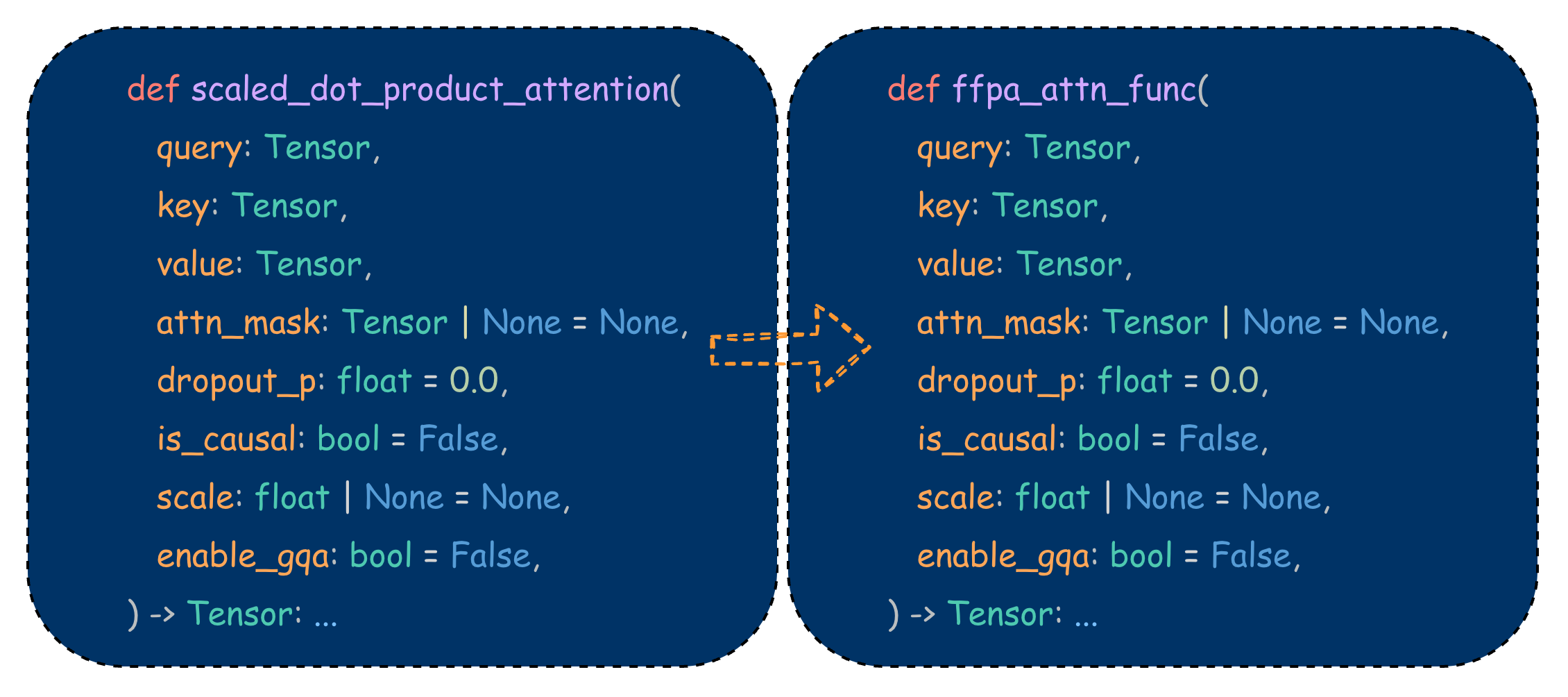
FFPA: Fast and Memory-Efficient Exact Attention for Large Headdim, achieving O(1) SRAM complexity (w/ Split-D) and O(d/4) register complexity, 1.5x~6x speedup over standard PyTorch SDPA. FFPA extends the headdim support beyond D > 256 (up to 1024) without any precision loss.
| Self Attn | GQA/MQA | Cross Attn | Causal/Mask | Dropout | Headdim | Fwd/Bwd |
|---|---|---|---|---|---|---|
✔️(Nq=Nkv) |
✔️(Hq!=Hkv) |
✔️(Nq!=Nkv) |
✔️(attn_mask) |
✔️(p>0) |
320~1024 | 1.5x~6x↑ |
Latest News
- [2026/06] DefTruth, Butterfingrz, FFPA: Fast and Memory-Efficient Exact Attention for Large Headdim.
Quick Start
First, install the prebuilt package from PyPI or build ffpa-attn from source:
# First, install the prebuilt package from PyPI
pip3 install -U ffpa-attn # CUDA 13.0+, PyTorch 2.11+
# Or, build ffpa-attn from source, just follow the cmds
git clone https://github.com/xlite-dev/ffpa-attn.git
# Then, build the wheel package (Triton + CuTeDSL backends)
cd ffpa-attn && pip3 install -e . --no-build-isolation
# Optional: install ffpa-attn w/ CUDA backend (forward only)
bash ./build.sh --arch sm_120f --ext all --headdim all
Then, try to accelerate the attention for large headdim with just one-line of code:
>>> import torch.nn.functional as F
>>> from ffpa_attn import ffpa_attn_func
>>> # Monkey-patch SDPA to point to FFPA. Every thing that FFPA
>>> # does not support will auto fallback to SDPA: D <= 256, etc.
>>> F.scaled_dot_product_attention = ffpa_attn_func # one-line code
For more advanced features, please refer to our online docs at 📘ffpa-attn.io.
Note
FFPA supports cross-attention where the query seqlen Nq may differ from the key/value seqlen Nkv, GQA / MQA attention where Q has Nh_q heads and K/V have Nh_kv heads (requires Nh_q % Nh_kv == 0; group size = Nh_q / Nh_kv), and causal attention (pass is_causal=True; queries are aligned to the KV tail, i.e. Q row r attends to k <= r + (Nkv - Nq), which requires Nkv >= Nq). K/V must share the same Nh_kv and Nkv. enable_gqa now defaults to False to match SDPA exactly, so GQA/MQA usage must pass enable_gqa=True explicitly.
Minimal usage example — Self-Attention (B=1, H=32, N=8192, D=512):
import torch
import torch.nn.functional as F
from ffpa_attn import ffpa_attn_func

# D: 32, 64, ..., 320, ..., 1024 (FA-2 <= 256, FFPA supports up to 1024).
B, H, N, D = 1, 32, 8192, 512 # batch_size, num_heads, seq_len, head_dim
q = torch.randn(B, H, N, D, dtype=torch.bfloat16, device="cuda")
k = torch.randn(B, H, N, D, dtype=torch.bfloat16, device="cuda")
v = torch.randn(B, H, N, D, dtype=torch.bfloat16, device="cuda")

# FFPA self attention; layout follows SDPA: (B, H, N, D).
out = ffpa_attn_func(q, k, v)  # -> torch.Tensor of shape (B, H, N, D)
print(out.shape, out.dtype)

ref = F.scaled_dot_product_attention(q, k, v)
print(f"vs SDPA max_abs_err={(out - ref).abs().max().item():.4e}")
Cross-Attention or Decoding-Attention example (short query, long KV cache; Nq != Nkv):
import torch
import torch.nn.functional as F
from ffpa_attn import ffpa_attn_func

# Short-query / long-KV, e.g. incremental decoding or cross-attention:
# Q: [B, H, Nq, D], K/V: [B, H, Nkv, D]; Nq can differ from Nkv but Nk==Nv required.
B, H, D = 1, 8, 512
Nq, Nkv = 128, 8192
q = torch.randn(B, H, Nq,  D, dtype=torch.bfloat16, device="cuda")
k = torch.randn(B, H, Nkv, D, dtype=torch.bfloat16, device="cuda")
v = torch.randn(B, H, Nkv, D, dtype=torch.bfloat16, device="cuda")

out = ffpa_attn_func(q, k, v)  # -> (B, H, Nq, D) = (1, 8, 128, 512)
print(out.shape, out.dtype)

ref = F.scaled_dot_product_attention(q, k, v)
print(f"vs SDPA max_abs_err={(out - ref).abs().max().item():.4e}")
Grouped-Query / Multi-Query Attention example (Q has more heads than K/V):
import torch
import torch.nn.functional as F
from ffpa_attn import ffpa_attn_func

# GQA: Q has Nh_q heads, K/V share Nh_kv heads; group_size = Nh_q / Nh_kv.
# Typical Llama-3-style 32/8 ratio; MQA is the Nh_kv==1 special case.
# FFPA targets large headdim so we use D=512 here (FA-2 tops out at D=256).
# enable_gqa defaults to False, so opt into GQA semantics explicitly.
B, D, Nq, Nkv = 1, 512, 1024, 4096
Nh_q, Nh_kv = 32, 8  # group_size = 4
q = torch.randn(B, Nh_q,  Nq,  D, dtype=torch.bfloat16, device="cuda")
k = torch.randn(B, Nh_kv, Nkv, D, dtype=torch.bfloat16, device="cuda")
v = torch.randn(B, Nh_kv, Nkv, D, dtype=torch.bfloat16, device="cuda")

out = ffpa_attn_func(q, k, v, enable_gqa=True)  # -> (B, Nh_q, Nq, D) = (1, 32, 1024, 512)
print(out.shape, out.dtype)

# Reference: replicate K/V along head dim to match Q's head count.
group_size = Nh_q // Nh_kv
k_ref = k.repeat_interleave(group_size, dim=1)
v_ref = v.repeat_interleave(group_size, dim=1)
ref = F.scaled_dot_product_attention(q, k_ref, v_ref)
print(f"vs SDPA max_abs_err={(out - ref).abs().max().item():.4e}")
Causal Attention example (self-attention causal; also supports chunked / decoding prefill with Nkv > Nq):
import torch
import torch.nn.functional as F
from ffpa_attn import ffpa_attn_func

# Causal self-attention: Q row r attends to k <= r (standard triangular mask).
# FFPA is tuned for large headdim, so we keep D=512 as in the self-attn example.
B, H, N, D = 1, 8, 4096, 512
q = torch.randn(B, H, N, D, dtype=torch.bfloat16, device="cuda")
k = torch.randn(B, H, N, D, dtype=torch.bfloat16, device="cuda")
v = torch.randn(B, H, N, D, dtype=torch.bfloat16, device="cuda")

out = ffpa_attn_func(q, k, v, is_causal=True)
print(out.shape, out.dtype)

ref = F.scaled_dot_product_attention(q, k, v, is_causal=True)
print(f"vs SDPA max_abs_err={(out - ref).abs().max().item():.4e}")

# Chunked / decoding prefill: Nq < Nkv, queries aligned to the KV tail
# so Q row r attends to k <= r + (Nkv - Nq). Requires Nkv >= Nq.
# This example keeps D=512 so it stays on the FFPA large-D path. For D <= 256,
# ffpa_attn_func forwards the inputs directly to SDPA without synthesizing a
# causal cross-attention mask for you.
Nq, Nkv = 128, 8192
q = torch.randn(B, H, Nq,  D, dtype=torch.bfloat16, device="cuda")
k = torch.randn(B, H, Nkv, D, dtype=torch.bfloat16, device="cuda")
v = torch.randn(B, H, Nkv, D, dtype=torch.bfloat16, device="cuda")
out = ffpa_attn_func(q, k, v, is_causal=True)
print(out.shape, out.dtype)  # (1, 8, 128, 512)
Backward Pass example (compare dQ / dK / dV against SDPA):
import math
import torch
import torch.nn.functional as F
from ffpa_attn import ffpa_attn_func

# Focus on a large-headdim case where FFPA is typically used.
B, H, N, D = 1, 32, 8192, 512
scale = 1.0 / math.sqrt(D)

q = torch.randn(B, H, N, D, dtype=torch.bfloat16, device="cuda", requires_grad=True)
k = torch.randn(B, H, N, D, dtype=torch.bfloat16, device="cuda", requires_grad=True)
v = torch.randn(B, H, N, D, dtype=torch.bfloat16, device="cuda", requires_grad=True)

out = ffpa_attn_func(q, k, v, scale=scale)
out.sum().backward()

dq = q.grad.detach().clone()
dk = k.grad.detach().clone()
dv = v.grad.detach().clone()

q_ref = q.detach().clone().requires_grad_(True)
k_ref = k.detach().clone().requires_grad_(True)
v_ref = v.detach().clone().requires_grad_(True)
out_ref = F.scaled_dot_product_attention(q_ref, k_ref, v_ref, scale=scale)
out_ref.sum().backward()

print(f"dQ vs SDPA dQ max_abs_err={(dq - q_ref.grad).abs().max().item():.4e}")
print(f"dK vs SDPA dK max_abs_err={(dk - k_ref.grad).abs().max().item():.4e}")
print(f"dV vs SDPA dV max_abs_err={(dv - v_ref.grad).abs().max().item():.4e}")
Split-D and TiledMMA
We extend FlashAttention to support large headdim ($D>256$) via fine-grained tiling at the MMA level for $QK^\top$ and $PV$ matrix multiplication. Two orthogonal $O(D)$ bottlenecks — SRAM footprint and register pressure — are broken by Split-D and TiledMMA<4,2,1> respectively.
Split-D: The tiling of the $D$ axis breaks the SRAM bottleneck. A persist-D layout keeps $Q$ resident in SRAM at $O(D)$ ($D{=}512 \Rightarrow 192\text{KB} > 99\text{KB}$ per-CTA limit on sm_8x/sm_120). Split-D chunks the $D$ axis, keeping SRAM fixed at $B_r \times 16$ (with $B_r=B_c$) for Q, K and V, yielding constant SRAM complexity $O(B_r \times 16) \approx O(1)$.
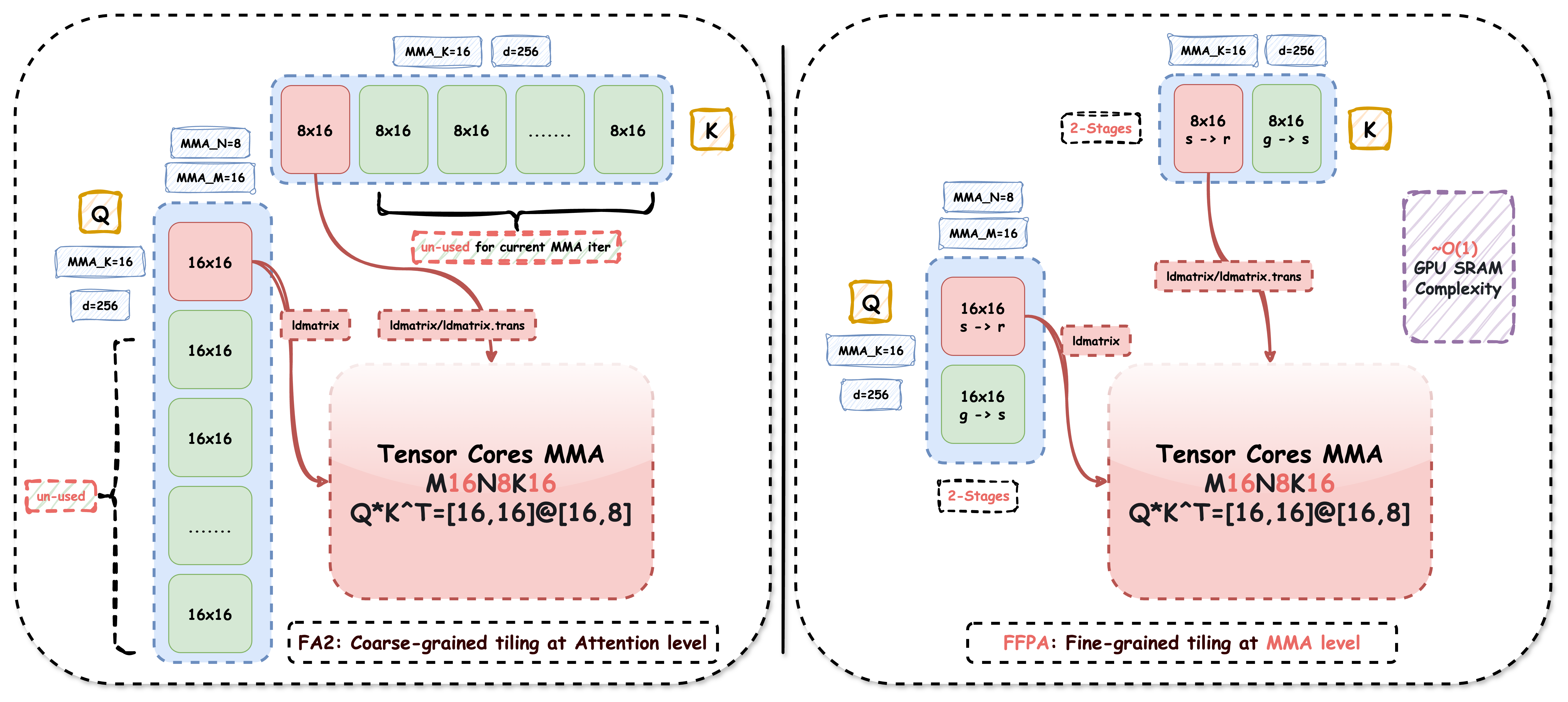
TiledMMA: The M4N2 layout breaks the register bottleneck. The $QK^\top$ has $N{=}B_c$ (fixed, independent of $D$), so its acc is $O(1)$; the $PV$ GEMM instead has $N{=}D$, so the $O$ acc costs $D/(2{\cdot}N_w)$ regs/thread. M8N1 (FA-2 style, $N_w{=}1$) $\Rightarrow O(D/2)$: at $D{=}512$ this already reaches 256 regs/thread, over the 255 architectural limit and spilling. Splitting $N$ to M4N2 (FA-1 style, $N_w{=}2$) halves it to $O(D/4)$, keeping $D{=}1024$ just feasible (256 regs/thread).

Dispatch: M8N1 for $D \le 512$, M4N2 for $D > 512$. On RTX 5090, M4N2 delivers 1.55× the throughput of M8N1 at $D{=}1024$ (154T vs 100T, where M8N1 collapses from register spilling).
Benchmark
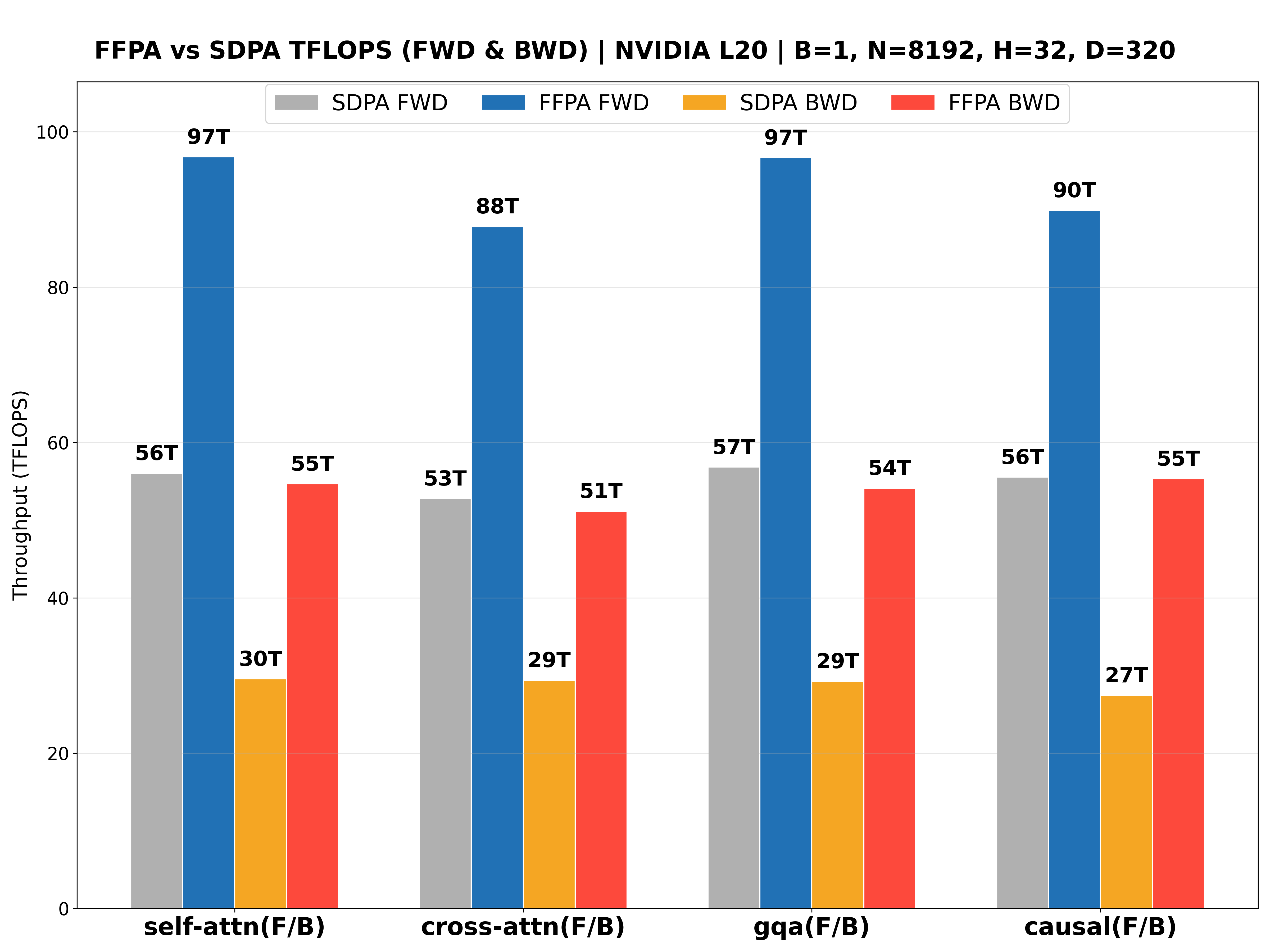
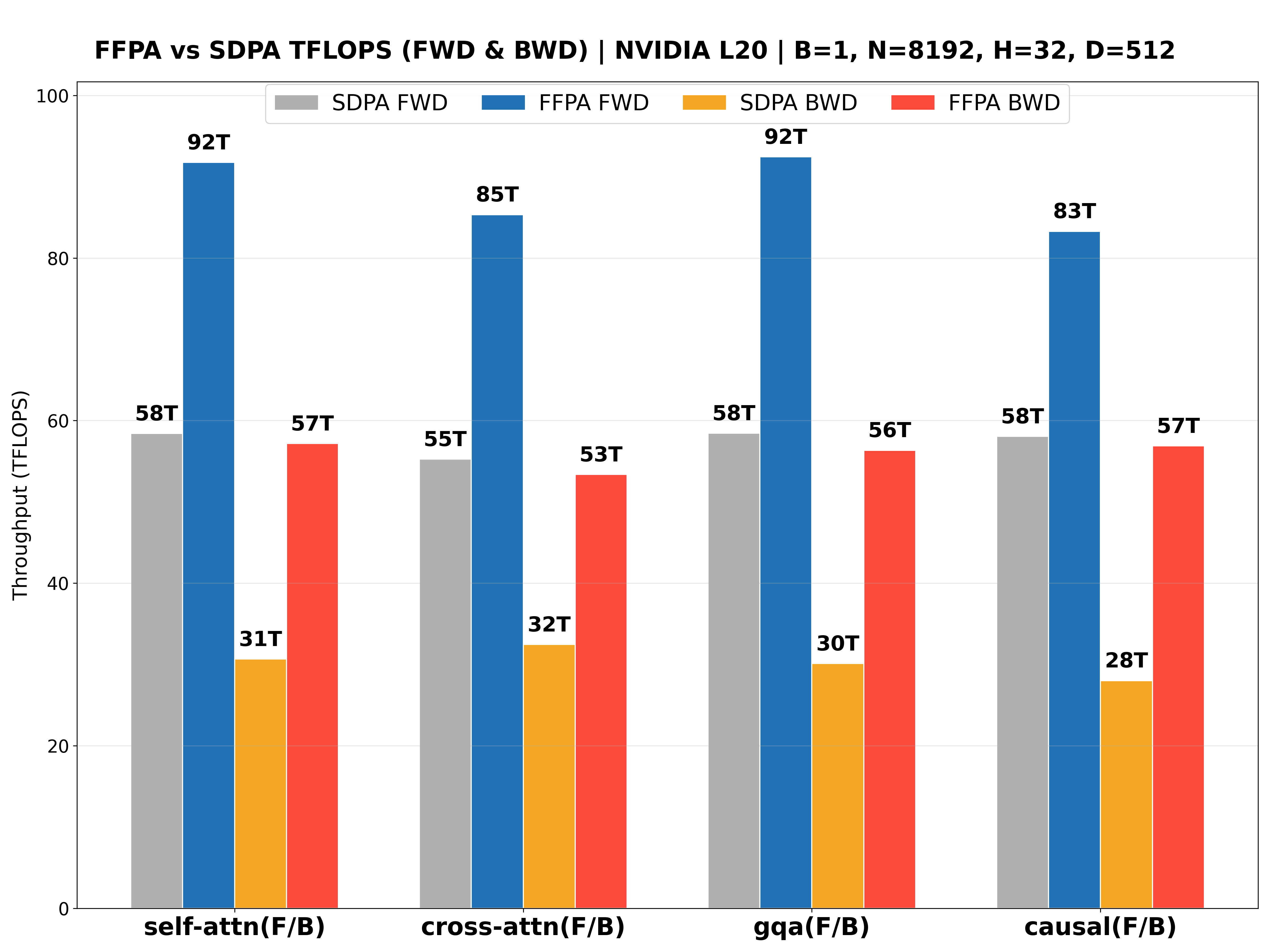
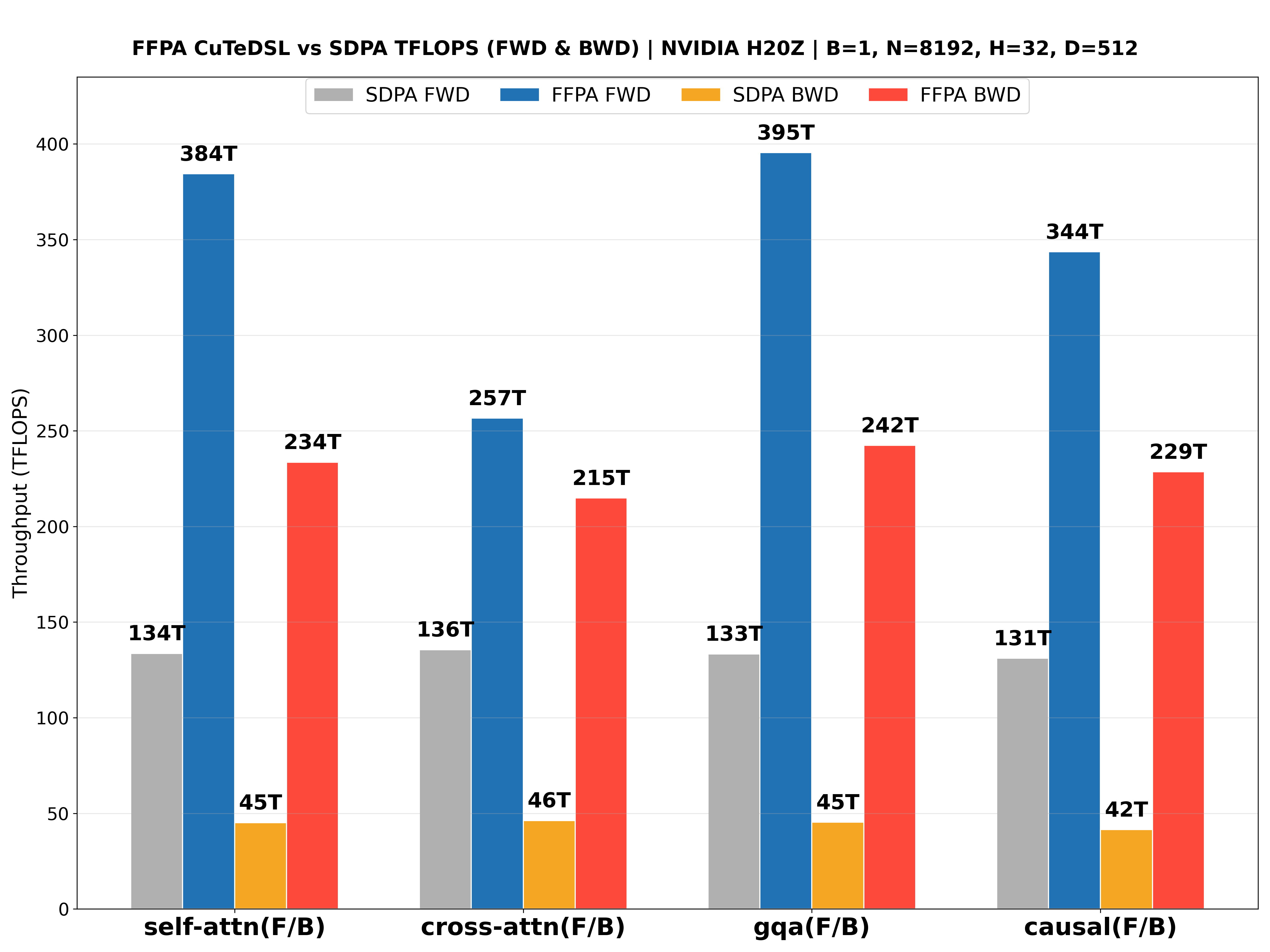
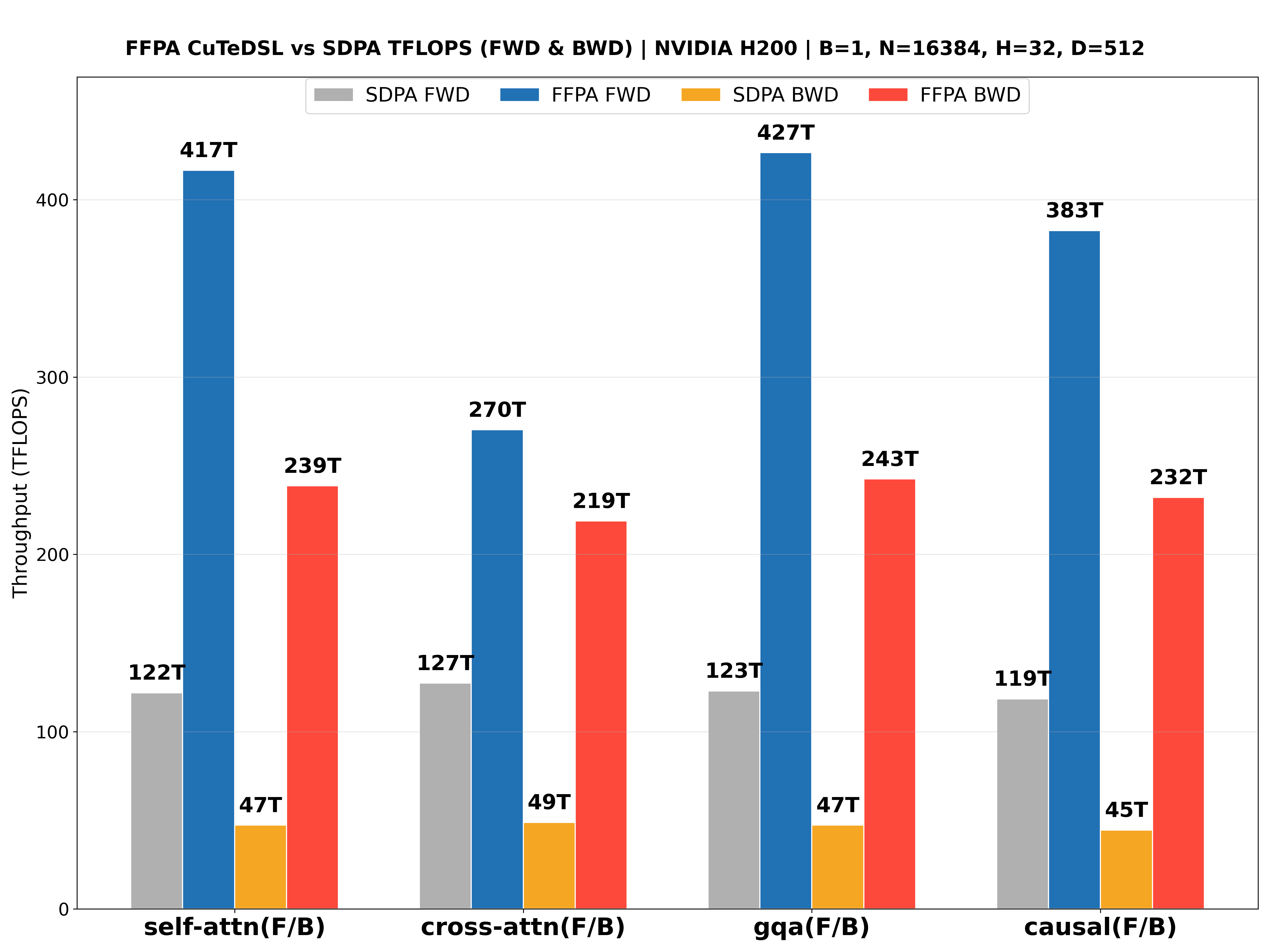
Runnable benchmark are provided under bench. The performance benchmarks for the NVIDIA L20 (Ada), NVIDIA Geforce RTX 5090 (Blackwell), NVIDIA H800 PCIE (Hopper), NVIDIA H200 SXM (Hopper, CuTeDSL backend, up to 513-535 TFLOPS!) with large headdims can be found at bench.
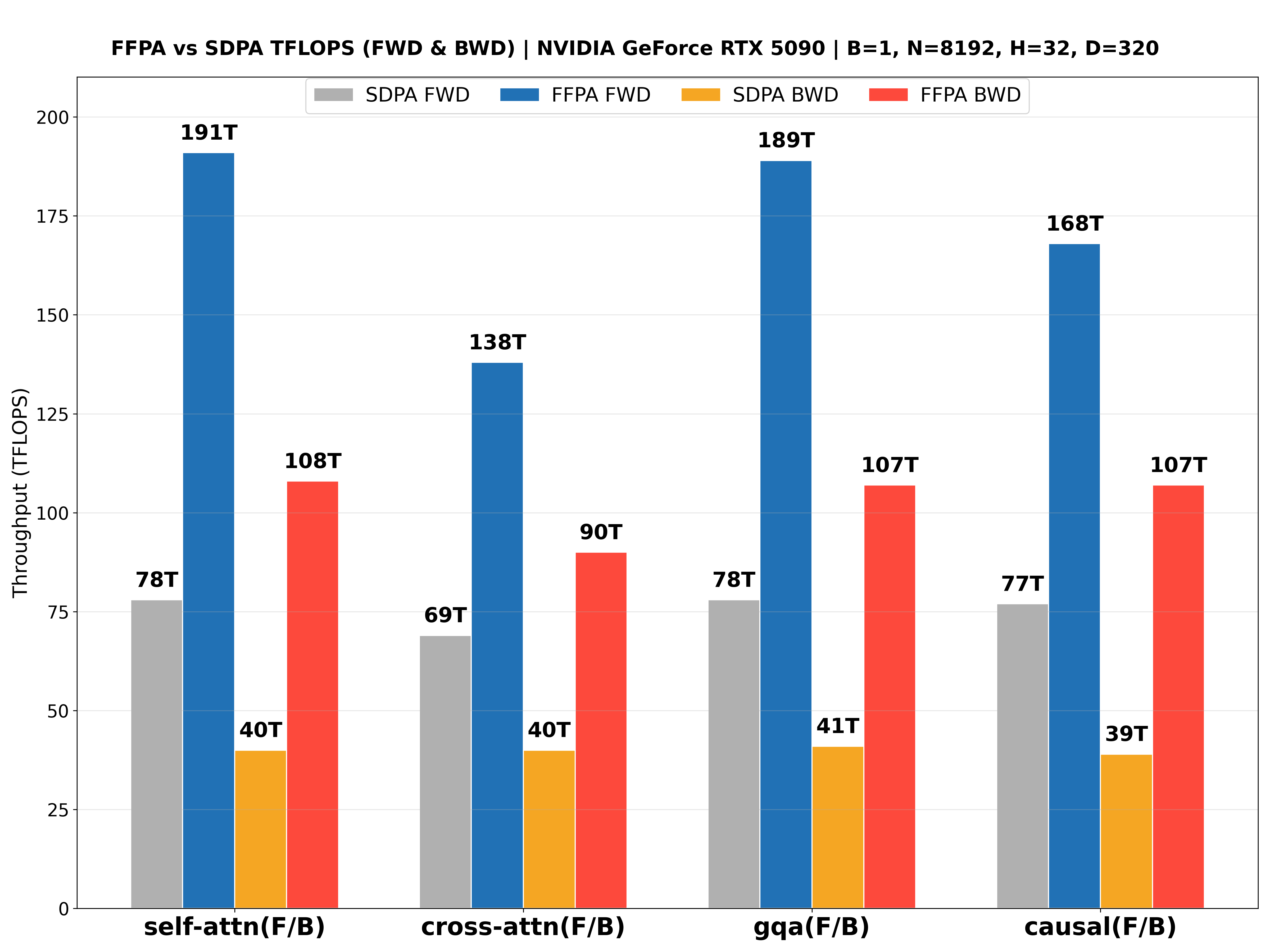
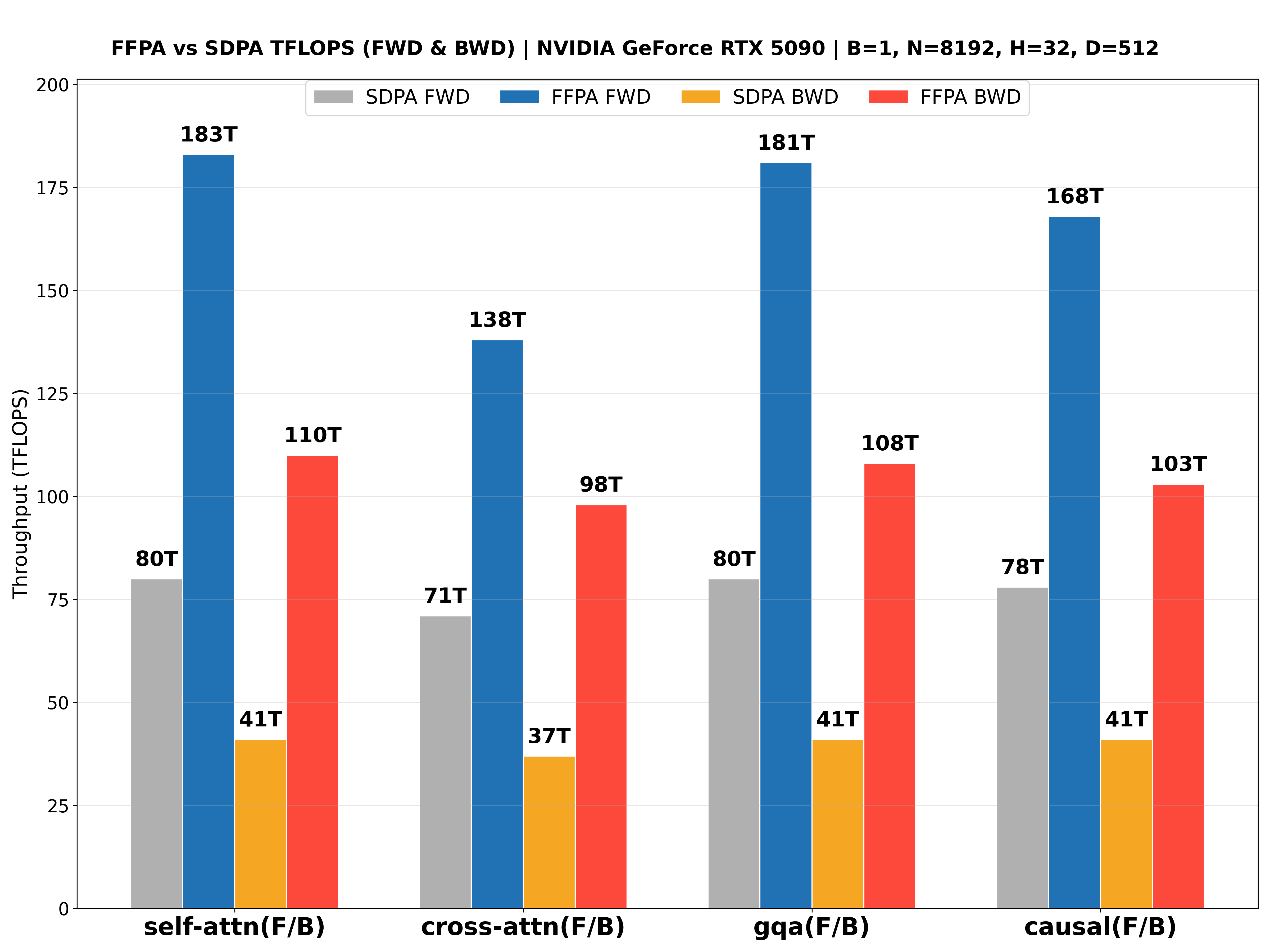
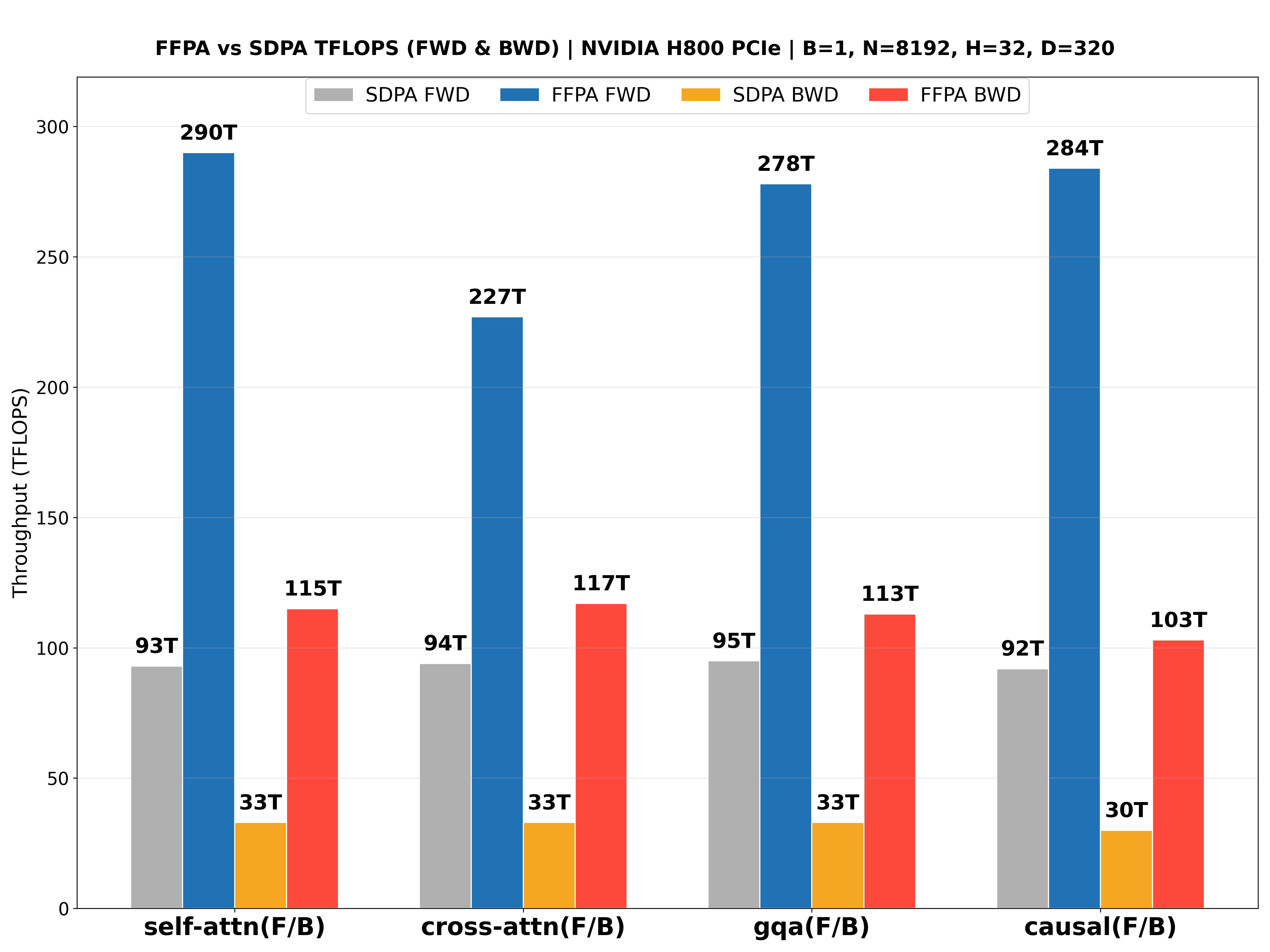
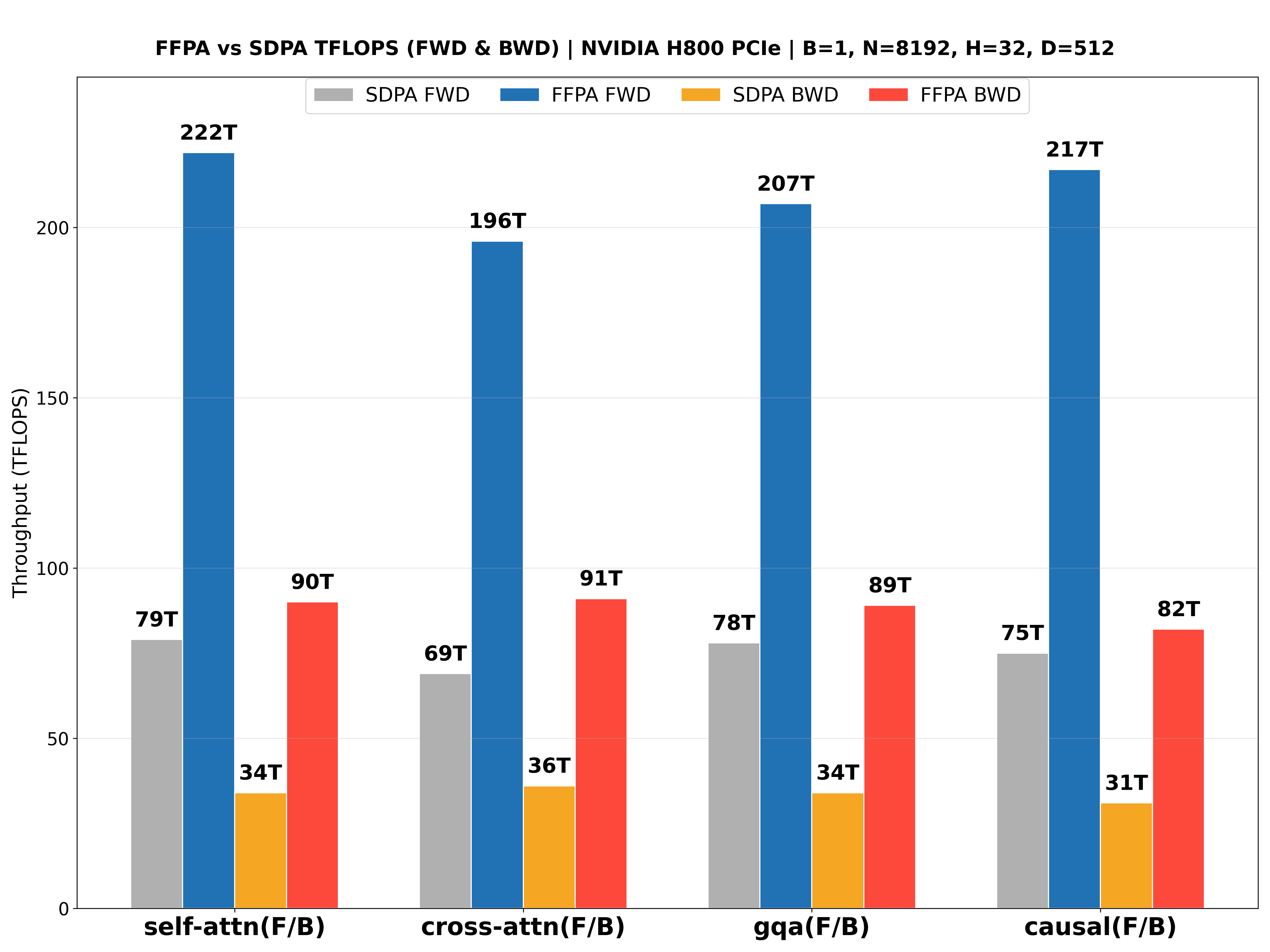
Backends
FFPA supports multiple backends for the forward and backward pass, including: SDPA (baseline), CUDA (forward only), Triton, and CuTe-DSL. The CuTe-DSL backend is currently in early stage and has some constraints, but it can achieve up to 535 TFLOPS on H200! Stay tuned for future updates.
| Backend | Arch | Fwd | Bwd | Headdim | Autotune | Speedup | Recommend |
|---|---|---|---|---|---|---|---|
| SDPA | sm>=75 | ✔ | ✔ | All | ✖️ | 1.0x | sm>=75 |
| CUDA | sm>=80 | ✔ | ✖️ | 320~1024 | ✖️ | 1.5x~3x | sm_80~89,120{a,f} |
| Triton | sm>=80 | ✔ | ✔ | 320~1024 | ✔ | 1.5x~5x | sm>=80 |
| CuTe-DSL | sm>=80 | ✔ | ✔ | 320~1024 | ✖️ | 1.5x~2x | sm_80~89,120{a,f} |
| CuTe-DSL | sm_90a | ✔ | ✔ | 320~512 | ✖️ | 3x~6x | sm_90a |
Note
AMD ROCm/HIP support: the Triton backend (forward + backward) also runs on AMD GPUs, install ffpa-attn into a ROCm build of PyTorch and it will dispatch to Triton AMD automatically. Validated on AMD Instinct MI250X (gfx90a, Linux) and Radeon RX 9070 XT (gfx1201, Windows).
How to use different backends for your own scenario? Users can simply pass the Backend configs (SDPABackend, CUDABackend, TritonBackend or CuTeDSLBackend) to ffpa_attn_func, for example:
>>> from ffpa_attn import ffpa_attn_func, CuTeDSLBackend
>>> # CuTe-DSL backend, D=512 scenario, fastest on H200!
>>> o = ffpa_attn_func(q, k, v, backend=CuTeDSLBackend())
Persistent Autotune
Generate device-specific tuned configs for production deployment (currently, Triton only), avoiding per-process autotune cost. The generated JSON is saved under configs dir and automatically loaded when runtime autotune is disabled (the default). See the docs of Triton Autotune for details.
python -m ffpa_attn.autotune --mode max --full-tasks --overwrite # 1 GPU
export CUDA_VISIBLE_DEVICES=0,1,2,3,4,5,6,7 # Multi-GPU (`pip install ray`)
python -m ffpa_attn.autotune --mode max --full-tasks --num-gpus 8 --overwrite
End-to-End (E2E) Training
NVIDIA-NeMo Automodel PR #2436 shows that on Gemma4-31B training (L=8192, 8xH200, FSDP2 + Activation Checkpointing), accelerating the 10/60 D=512 full-attention layers with FFPA delivers about 1.4x~1.5x higher throughput (E2E) than SDPA at similar memory footprint, with loss aligned within normal bf16 noise.

License
Apache License 2.0
Citations
@misc{deftruth2026ffpa,
  author       = {DefTruth and Butterfingrz},
  title        = {FFPA: Fast and Memory-Efficient Exact Attention for Large Headdim},
  year         = {2026},
  publisher    = {Zenodo},
  version      = {v1.0},
  doi          = {10.5281/zenodo.20638547},
  url          = {https://doi.org/10.5281/zenodo.20638547}
}